
The Benefits of Biofloc Technology — and What It Really Costs
The real benefits of biofloc — 80–90% less water, 10–30% feed saved, higher density — plus the honest costs. Numbers from working tilapia and shrimp farms.
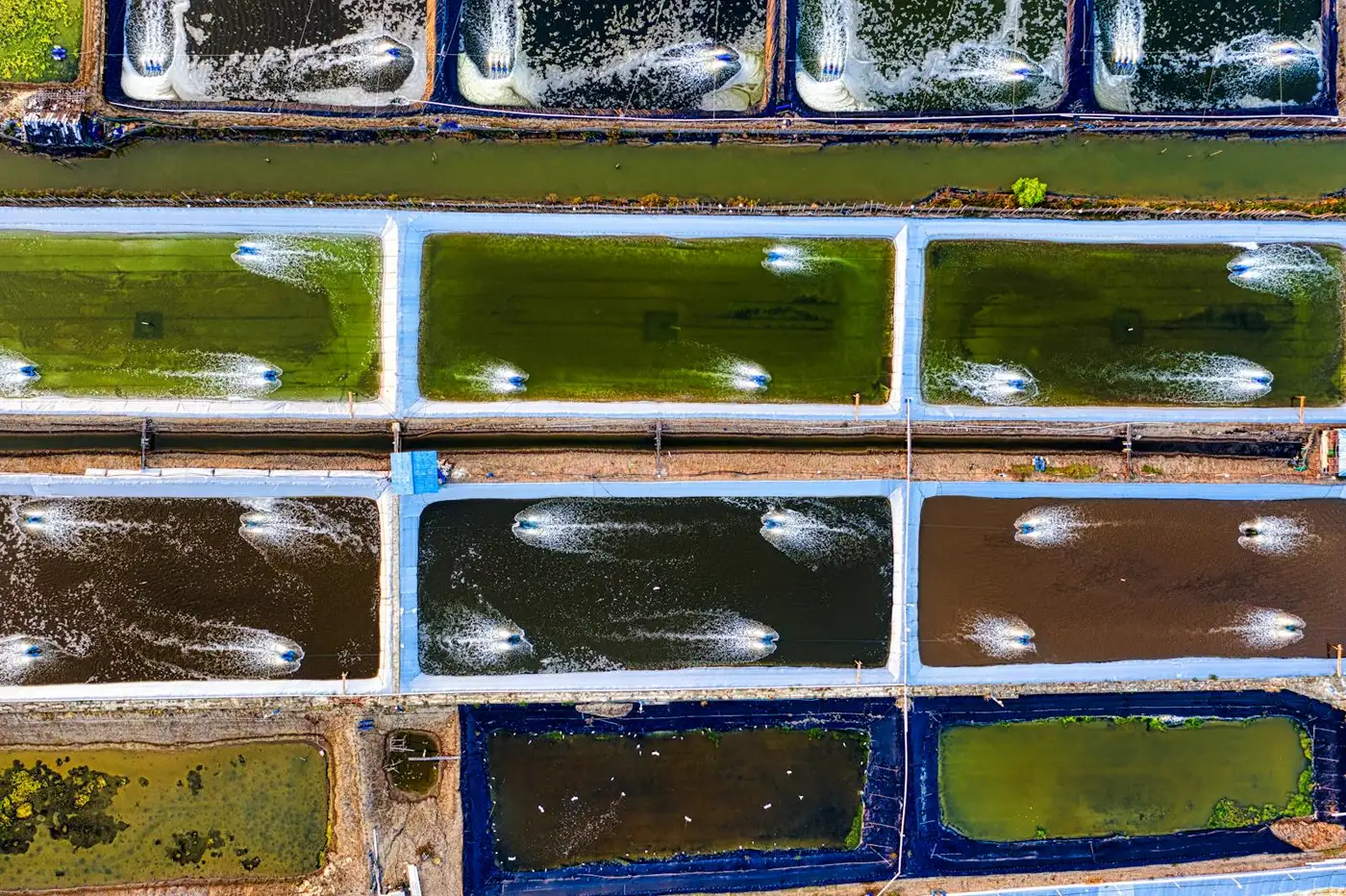
Biofloc technology pays you back in three currencies: water, feed and stocking density. A biofloc tank recycles fish waste in place instead of flushing it out, so you exchange almost no water, the floc itself feeds the fish, and you can stock far heavier than an earthen pond will tolerate. On a farm where feed and water are the two biggest bills, that is where the money is.
But biofloc is not free. It trades a water problem for a power problem, and a feed bill for a management bill. Below are the benefits with real numbers, and the costs we have watched farms underestimate — including our own customers in Asia and Africa.
The three benefits that actually move the P&L
1. Water: 80–90% less exchange
A flow-through or earthen pond dilutes ammonia by swapping water. Biofloc removes it biologically, so water exchange drops by 80–90% versus a conventional system. In places where water is metered, pumped from a borehole, or simply scarce in the dry season, that single number is often the whole reason a farm converts. Less water in also means less water out — fewer discharge problems and a smaller biosecurity hole for pathogens to enter.
2. Feed: floc replaces 10–30% of formulated feed
Feed is 50–60% of running cost on a typical tilapia or shrimp farm. In biofloc, the microbial floc is a 25–50% protein feed the fish graze on between meals, and it can replace 10–30% of formulated feed — sometimes more on tilapia, which eat floc readily. On a 10-tonne crop that is a real line on the invoice, repeated every cycle. The feed saving, not the water saving, is usually what tips the ROI positive.
3. Density and biosecurity: more kg on the same footprint
Because the water is actively managed, you can stock at higher kg/m³ than an open pond allows, and the closed system keeps out the pathogens that ride in on exchange water. More harvest per tank, on the same land, with fewer disease crashes — that is the density-and-biosecurity benefit that lets a small site behave like a bigger one.
Biofloc vs a traditional pond: the numbers side by side
| Traditional earthen pond | Biofloc system | |
|---|---|---|
| Water exchange | High, continuous | Cut 80–90% |
| Feed | 100% formulated | Floc replaces 10–30% |
| Stocking density | Low | High (kg/m³) |
| Biosecurity | Open to inflow | Closed, controlled |
| Power dependence | Low | Critical — 24/7 aeration |
| Skill needed | Moderate | High (first cycle) |
The table is the honest summary: biofloc wins on water, feed and density, and loses on power dependence and learning curve. Whether that trade is worth it depends on your feed price, your water cost and your power reliability.
Is biofloc profitable? The math behind the answer
It can be, and the calculation is mostly feed and water. Take a tilapia or shrimp operation where feed is 50–60% of cost and clean water is limited. The feed protein from floc, plus the extra kilos from higher density per tank, are what push the numbers into profit. The upfront cost sits in the durable kit — tanks, blowers, aeration grids — that lasts many cycles. Spread over those cycles, the per-kilo cost of equipment is small; the recurring feed and water savings are what compound.
The farms that lose money on biofloc almost always do it the same way: they cut the aeration budget to lower the upfront cost, then lose a batch when the blower fails. The aeration is not where you save.
What biofloc really costs — the honest trade-offs
Power dependence is the number-one risk. No aeration, no biofloc. A few hours without dissolved oxygen — a blown fuse, a grid outage — can kill an entire batch, because the dense floc and high stocking density that make biofloc productive also make it unforgiving. This is why a standby generator is treated as insurance, not a luxury, and why most farms run a root blower feeding a grid of nano aeration tubes sized with headroom.
Solids management is a daily job. Floc has to stay inside a window — a working range is about 200–500 mL/L of settled solids on an Imhoff cone. Too thin and the system stops feeding the fish; too thick and it strips oxygen and clogs gills. You read it, and you settle or filter the excess.
The first cycle is a learning curve. Biofloc is about reading water, not just feeding fish: the C:N ratio (around 15–20:1, held by dosing molasses or flour), dissolved oxygen above ~4–5 mg/L, and the settling volume. A multi-parameter water quality meter and aquaculture probiotics to steer the microbial community are what turn that learning curve from guesswork into a routine.
The water sits in a tank that has to hold it cleanly for the whole cycle — typically a PVC tarpaulin fish tank in the 650–750 GSM spec buyers ask for.
Which farms get the most benefit?
The biggest payback shows up where the benefits line up with the constraint:
- Water-scarce regions — the 80–90% water saving is decisive when water is metered or seasonal.
- High feed-cost operations — the 10–30% feed replacement compounds every cycle.
- Warm-water species that eat floc — tilapia, whiteleg shrimp (Vannamei), African catfish. Cold-water or oxygen-sensitive species benefit less.
This matches what we see in the field. SIGMA has supplied biofloc tanks and systems to Japfa (one of Asia’s largest aquaculture groups, a repeat buyer of our biofloc tilapia tanks) and to Tropo Farms in Ghana, with projects shipped to Mozambique and Bangladesh. The farms that capture the full benefit are the ones that respect the aeration and the solids from day one — the same lesson, every market.
If you are weighing biofloc’s benefits against a recirculating system, we compare the two head-to-head in Biofloc vs RAS: Cost, ROI and How to Choose. For the mechanism itself, see What Is Biofloc Technology and How Does It Work?
Frequently asked questions
What are the main benefits of a biofloc aquaculture system?
The key benefits are low water exchange, high animal density, no need for external biological filtration, typically no soil interaction, and suitability primarily for shrimp and tilapia.
How does low water exchange help a biofloc farm?
Low water exchange brings biosecurity, temperature control, and salt conservation — which allows inland marine (saltwater) operation.
Can biofloc systems reach high stocking densities?
Yes — biofloc supports intensive to superintensive density with indoor operation, climate control and use across diverse regions.
Does a biofloc system need a separate biofilter?
No — biofloc requires no external biological filtration, though solids filtration is common. It also typically has no soil interaction, using tanks, lined ponds, concrete vessels or raceways.
What species are biofloc systems mainly used for?
Primarily shrimp and tilapia, with other candidate taxa and life stages such as catfishes.
Put this into practice on your farm
Tell our engineers your species, target density and site — we will size the system and reply within one business day.
More to explore
- Trichodina in Tilapia: Symptoms, Diagnosis & Control
- White Spot Disease in Shrimp (WSSV): Prevention & Biosecurity
- Bacterial & Fungal Diseases in Sturgeon: Symptoms & Control
- Columnaris and Parasitic Diseases in Catfish
- Water Quality & Fish Disease: Why Most Outbreaks Start in the Water
Building a system from what you read here? Ask our engineers for a tailored plan →